Pharmaceuticals
Temperature and humidity monitoring for pharmaceuticals
TempTrack provides pharmaceutical wholesalers, pharmacies and laboratories with continuous temperature and humidity measurement in warehouses, cold rooms and medicine refrigerators. The system alerts on every deviation and keeps the records that Good Distribution Practice (GDP) guidelines call for.
Challenges
What is specific about medicines
01
An out-of-range medicine looks the same
A vaccine or insulin exposed to the wrong temperature looks unchanged but may lose efficacy. The only proof of integrity is the temperature record.
02
Regulatory requirements
GDP guidelines call for continuous monitoring of storage conditions, alarms on deviation and retained records.
03
Temperature mapping
Before a warehouse goes into use, a temperature mapping study finds the critical points where permanent sensors are then placed.
04
Humidity is a storage condition too
Many products also have an upper relative humidity limit, which has to be monitored alongside temperature.
Regimes
Typical temperature regimes
Indicative values. The storage conditions set by the medicine’s manufacturer are authoritative.
| Product / space | Regime |
|---|---|
| Cold chain (vaccines, insulins, biologics) | +2…+8 °C |
| Controlled room temperature | +15…+25 °C |
| Frozen productsper specification | ≤ −20 °C |
| Warehouse relative humiditytypical | ≤ 60 % RH |
TempTrack
How TempTrack helps
A continuous record with no gaps
Measurements are sent to the cloud and stored automatically, so there is a complete temperature and humidity record for any period.
An alarm on every deviation
When a refrigerator or cold room leaves its range, the responsible person is alerted and can act before the medicine is compromised.
Support for mapping
A dense grid of wireless sensors makes warehouse temperature mapping possible, followed by ongoing monitoring of the critical points.
Reports for inspection
Reports by room and period are ready for inspections and internal quality audits.
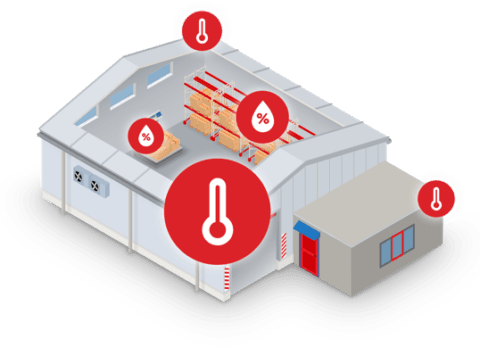
Where sensors are usually placed
- Controlled-room-temperature warehouse
- Cold rooms at +2…+8 °C
- Medicine refrigerators and freezers
- Receiving and dispatch areas
- Quarantine and returns area
- Distribution vehicles
Frequently asked questions
What is warehouse temperature mapping?
It is a study in which temperature is measured at many points in a warehouse over a set period, to establish where the warmest and coldest spots are. It is described in World Health Organization technical guidance and is the basis for placing permanent sensors.
Does TempTrack measure humidity as well?
Yes. Every sensor measures temperature and relative humidity, with separate alert limits.
How long is data kept?
Measurements are stored on the cloud platform and remain available for analysis and reports on past periods. The retention period is aligned with your procedures.
Other industries
≤ +7 °C
Meat processing
Slaughterhouses, cutting plants and meat processing: chill rooms, blast freezers and curing rooms under constant watch.
+2…+8 °C
Dairy
From raw milk intake to cheese ripening and dispatch: every step of the cold chain is documented.
−18 / +4 °C
Distribution & logistics
Distribution centres, cold stores and vehicles: proof that goods stayed in regime from receipt to delivery.
HACCP
Food production
Bakeries, confectionery, fruit and vegetable processing, ready meals: temperature and humidity in production and storage.
90–95 % RH
Cold storage & agriculture
Fruit and vegetable cold stores, ULO chambers and farms: the harvest kept safe until it is sold.
0…+4 °C
Restaurants & hospitality
Restaurant chains, central kitchens and catering: every fridge and cold room at every outlet on one screen.
See how TempTrack would work at your site
Tell us how many cold rooms or warehouses you have. We will show you the system in action and suggest a sensor layout.